The UK government
Strictly His Majesty's Government .....

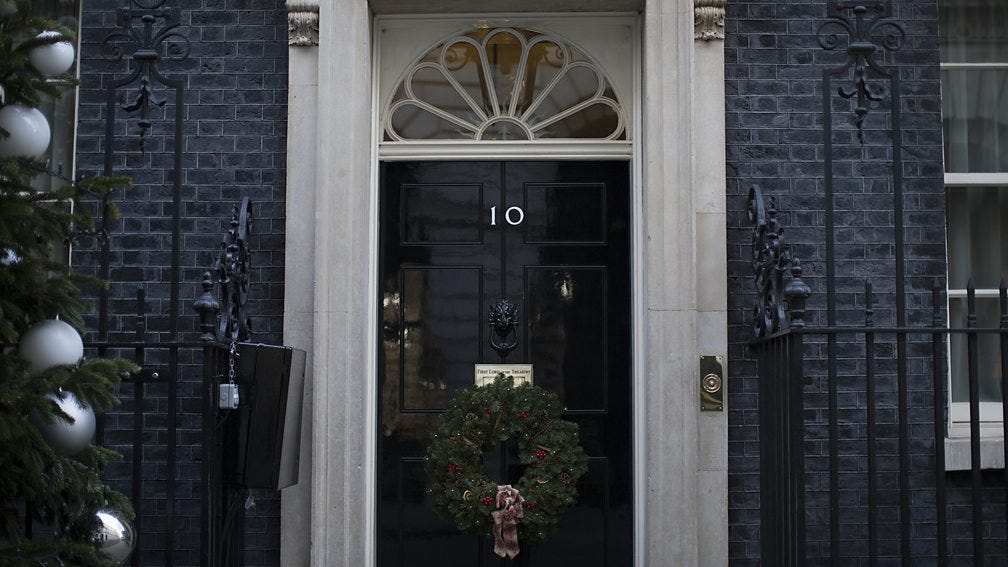
Monday 20 July 2026 saw the departure from Downing Street of Sir Keir Starmer who, following the general election of 2024, had served as Prime Minister from 5 July 2024.
The official formalities flowed seamlessly in time-honoured fashion with Starmer heading to see HM The King at Buckingham Palace to be followed by Andrew Murray Burnham arriving to be appointed Prime Minister and First Lord of the Treasury.
After appointment, Burnham set about appointing Ministers to the various posts - Chancellor of the Exchequer, Home Secretary, Foreign Secretary, Defence Secretary and so on.
All of that is entirely within the constitutional arrangements of the UK.1 By convention (not law), the Prime Minister is the individual best able to command the confidence of a majority in the House of Commons.2 The Prime Minister has the authority to appoint Ministers and remove them although, as a matter of law, such actions are approved by the King.
Burnham becomes the UK’s 7th Prime Minister since 2010. Here are the previous six:
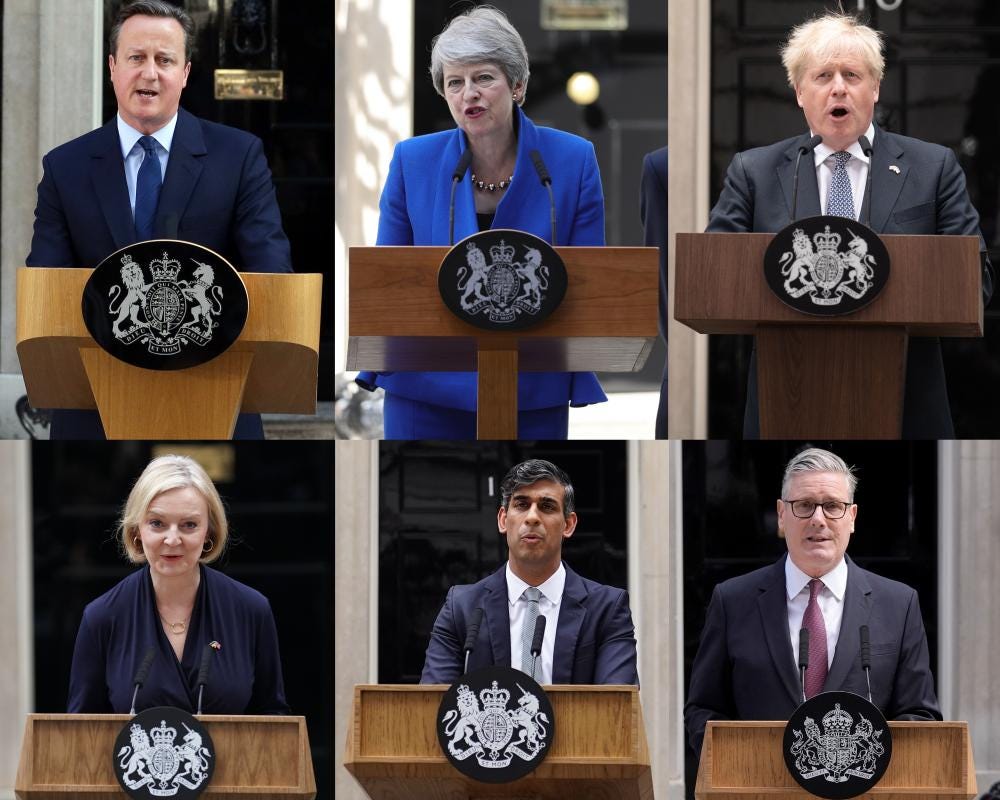
(Top row: David Cameron (now Lord Cameron), Theresa May (now Baroness May), Boris Johnson, Elizabeth Truss, Rishi Sunak, Sir Keir Starmer).
Such a rate of change is perhaps undesirable but there is nothing unlawful about it - Britain’s Revolving Door: Why the U.K. Has Had Six Prime Ministers in Less Than a Decade. The British people will eventually have their say although a general election need not take place until 2029. Of course, an election may come about before then if the Prime Minister advises the King to dissolve Parliament.
The Labour Party continues to hold its large majority in Parliament and can choose to use that wisely or otherwise! Their “mandate” stems from the 2024 general election but it is inevitable that, as time passes and as events unfold, the mandate becomes of lesser significance. It does not bind the government in law.
Looking to the immediate future, the Clacton by-election is due on 13 August and is likely to be won by Nigel Farage of the Reform UK Party. Farage decided to resign as MP and has tried to frame the by-election as “the people v the establishment” but the main Westminster parties decided not to contest the election. Farage’s resignation suspended a parliamentary investigation into certain financial matters but this could be resumed if he is elected.
The candidates standing in the Clacton by-election - BBC News
The candidates standing in the Clacton by-election - BBC News
As the blogger David Allen Green states, the appointment of Burnham is remarkable in that he has been brought into Parliament rather than being selected from existing MPs. As Green notes, 650 MPs were elected at the last general election but “the new Prime Minister had to be shipped in from outside parliament.”
Another new Prime Minister... - by d. a. t. green
New Ministers:
A list of appointments may be seen at - Andy Burnham's Government: Who are all the ministers appointed by the new PM? | The Standard.
Future?
Whilst nothing done during Starmer’s replacement is either unconstitutional or unlawful, it is an open question as to whether the UK ought to continue along the same lines and also a number of other important constitutional questions require to be addressed - (e.g. whether the UK continues with the first past the post system for Westminster elections etc).
It is certainly not unrealistic to think that a much more illiberal government may come about after the next election especially if the Labour Party under Burnham is not widely seen as successful across the whole range of government. The possible consequences of that will merit a further article.
Meanwhile, there are numerous proposals for constitutional change - Safeguarding the constitution - by Joshua Rozenberg. Also see Devolution plans strengthen case for written UK constitution, says Burnham | Constitutional reform | The Guardian.
The UK does not have a formal, codfied, written constitution. Hence the term constitutional arrangements.
Conventions are generally accepted practices applied in particular situations but they are not law. The courts of law my note the existence of a convention but they do not enforce them.