The Balfour Declaration 1917
and the British mandate for Palestine

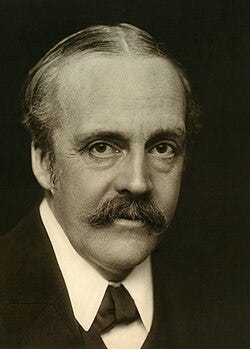
Image: Arthur James Balfour - UK Foreign Secretary - Prime minister 1902 - 1905 and foreign secretary 1916 - 1919.
The Balfour Declaration 1917 refers to a letter sent from the British foreign secretary - Arthur James Balfour (1848 - 1930) - to Lionel Walter Rothschild (1868 - 1937 - 2nd Baron Rothschild of Tring), a leader of the Anglo-Jewish community. Here is the text of the letter:
Dear Lord Rothschild,
I have much pleasure in conveying to you. on behalf of His Majesty's Government, the following declaration of sympathy with Jewish Zionist aspirations which has been submitted to, and approved by, the Cabinet
His Majesty's Government view with favour the establishment in Palestine of a national home for the Jewish people, and will use their best endeavors to facilitate the achievement of this object, it being clearly understood that nothing shall be done which may prejudice the civil and religious rights of existing non-Jewish communities in Palestine or the rights and political status enjoyed by Jews in any other country.
I should be grateful if you would bring this declaration to the knowledge of the Zionist Federation.
Yours,
Arthur James Balfour
As Encylopedia Britannica notes -
‘The Balfour Declaration, issued through the continued efforts of Chaim Weizmann (1874 - 1952) and Nahum Sokolow (1861 - 1936) Zionist leaders in London, fell short of the expectations of the Zionists, who had asked for the reconstitution of Palestine as “the” Jewish national home. The declaration specifically stipulated that “nothing shall be done which may prejudice the civil and religious rights of existing non-Jewish communities in Palestine.” The document, however, said nothing of the political or national rights of these communities and did not refer to them by name. Nevertheless, the declaration aroused enthusiastic hopes among Zionists and seemed the fulfillment of the aims of the World Zionist Organization (see Zionism).
The Declaration was endorsed by the principal Allied powers and was included in the British mandate over Palestine, formally approved by the newly created League of Nations on July 24, 1922.
The British mandate 1917 - 48
The period of the British mandate is described in this useful video …..
In May 1948, the Labour (Attlee) government in the UK chose to end its mandate.
On 14 May 1948, the State of Israel was unilaterally declared, a day before the British Mandate officially expired.
Middle East Eye (14 May 2025) Nakba: The Palestinian catastrophe, explained describes events in Palestine during 1948. The Nakba (or catastrophe) is marked each year on 15 May.
The Balfour Declaration is now a problematic part of the history. The 76 long and turbulent years from 1948 to the present day are the subject of libraries of books and numerous videos. International efforts to achieve a lasting peace have failed. This makes one wonder whether a “two State solution” as advocated by the UK and others will ever be a viable option. However that may be, it remains UK foreign policy.
The latest development is the current Labour government’s announcement that it will recognise a State of Palestine in September unless Israel takes "substantive steps to end the appalling situation in Gaza.” There are other conditions including agreeing to a ceasefire, committing to a long-term sustainable peace that delivers a two-state solution, and allowing the United Nations to restart the supply of aid - BBC News 29 July 2025. Israeli prime minister Benjamin Netanyahu said the move "rewards Hamas's monstrous terrorism."
Whether the latest UK action can be more than just a symbolic gesture is examined by this BBC article published on 29 July. This argues that -
‘The conditions are designed to put pressure on Israel to change course.
However, the US has far greater influence over Israel - and the country's long-standing position is to only recognise a Palestinian state as part of moves towards a long-term resolution to the conflict.
Donald Trump has suggested doing so now would "reward Hamas".
Sir Keir wants to show he is a serious leader who can have a real impact on the global stage.
Whether that aim is realised is now, largely, in the hands of Netanyahu and Trump.’
That seems to me to be a realistic assessment. Starmer may well wish to have an impact on the global stage but it is questionable how much international influence the UK truly has. Starmer’s focus ought really to be fully on dealing with the appalling problems that exist in present-day UK.
Footnote
The ‘State of Palestine’ is currently recognised by 147 of the UN's 193 member states. At the United Nations, it has the status of a "permanent observer state", allowing participation but no voting rights.
Links
National Army Museum - The British Army in Palestine
History of Palestine - Timeline
31 July 2025
BBC News - US allies break with Trump to force diplomatic shift on Gaza
BBC News - What does recognising a Palestinian state mean?
2 August 2025
BBC - Thank you, but it’s too late: Why some Palestinians aren’t convinced by Starmer’s promise