National Security Strategy 2025


NATO Summit
NATO was formed in 1949 with 12 member States. It now has 32 members - (LIST).
Against a background of on-going war in Ukraine as well as conflict between Israel and Iran, a summit was held at The Hague over 24 and 25 June 2025. The following declaration was issued. I have highlighted key phrases …
We, the Heads of State and Government of the North Atlantic Alliance, have gathered in The Hague to reaffirm our commitment to NATO, the strongest Alliance in history, and to the transatlantic bond. We reaffirm our ironclad commitment to collective defence as enshrined in Article 5 of the Washington Treaty – that an attack on one is an attack on all. We remain united and steadfast in our resolve to protect our one billion citizens, defend the Alliance, and safeguard our freedom and democracy.
United in the face of profound security threats and challenges, in particular the long- term threat posed by Russia to Euro-Atlantic security and the persistent threat of terrorism, Allies commit to invest 5% of GDP annually on core defence requirements as well as defence-and security-related spending by 2035 to ensure our individual and collective obligations, in accordance with Article 3 of the Washington Treaty. Our investments will ensure we have the forces, capabilities, resources, infrastructure, warfighting readiness, and resilience needed to deter and defend in line with our three core tasks of deterrence and defence, crisis prevention and management, and cooperative security.
Allies agree that this 5% commitment will comprise two essential categories of defence investment. Allies will allocate at least 3.5% of GDP annually based on the agreed definition of NATO defence expenditure by 2035 to resource core defence requirements, and to meet the NATO Capability Targets. Allies agree to submit annual plans showing a credible, incremental path to reach this goal. And Allies will account for up to 1.5% of GDP annually to inter alia protect our critical infrastructure, defend our networks, ensure our civil preparedness and resilience, unleash innovation, and strengthen our defence industrial base. The trajectory and balance of spending under this plan will be reviewed in 2029, in light of the strategic environment and updated Capability Targets. Allies reaffirm their enduring sovereign commitments to provide support to Ukraine, whose security contributes to ours, and, to this end, will include direct contributions towards Ukraine’s defence and its defence industry when calculating Allies’ defence spending.
We reaffirm our shared commitment to rapidly expand transatlantic defence industrial cooperation and to harness emerging technology and the spirit of innovation to advance our collective security. We will work to eliminate defence trade barriers among Allies and will leverage our partnerships to promote defence industrial cooperation.
We express our appreciation for the generous hospitality extended to us by the Kingdom of the Netherlands. We look forward to our next meeting in Türkiye in 2026 followed by a meeting in Albania.
(NATO: The Hague Declaration 25 June 2025)
Without doubt, the increase in expenditure was a “win” for US President Trump who was repeatedly critical of the low level of defence spending by some NATO members - (The Guardian 26 June 2025). Whether Trump is actually 100% behind the “iron clad commitment to collective defence” is a moot point.
Overall, the summit was essentially about keeping Trump “on-side” - hence the rise to 5% GDP - albeit by 2035.
UK / Ukraine
On 24 February 2022, the Russian President Vladimir Putin commenced what was then called a “special military operation” against Ukraine. From Boris Johnson in 2022 to Keir Starmer in 2025, successive UK Prime Ministers have supported Ukraine.
On 25 June, the British government announced that “UK will boost Ukraine’s air defence with 350 missiles using funds from seized Russian assets, helping to protect Ukrainians from Putin’s attacks” - (for further detail see the announcement 25 June 2025).
UK Strategic Defence Review
The UK’s strategic defence review (SDR) was presented to Parliament on 2 June 2025. I looked at this in a previous item on this substack. The SDR is the government’s approach to making UK armed forces stronger in the face of threats in the world of today.
On 19 June 2025, an article by Emily Ferris on the Royal United Services Institute (RUSI) website attempted to “get under the skin of how the Russians see us” and it is worth reading in full - RUSI Kremlin views UK’s SDR as a declaration of war.
UK - Russia relations have been, to say the least, unfriendly for some years and there can surely be no doubt that President Vladimir Putin operates a regime that is murderous to its opponents (e.g. Litvinenko 2006, Novichok in Salisbury 2018, Prigozhin 2023, Navalny 2024 etc). It seems highly doubtful that relations will improve as long as Putin remains Russia’s Head of State.
Fighter jets - the F35A
Since May 2025, the Royal Air Force / Royal Navy have operated US built Lockheed Martin F35 aircraft. The variant in service up to now has been the F35B which is also called Lightning.
In June 2025, the UK government announced plans to procure 12 F-35As, capable of delivering both conventional and nuclear weapons, including the B61-12 thermonuclear gravity bomb. A further 15 F-35Bs are also planned.
According to the UK government’s announcement (24 June 2025) the UK intends to buy “at least” a dozen of this dual capability aircraft which can carry both nuclear and conventional weapons.
“The purchase represents the biggest strengthening of the UK’s nuclear posture in a generation. It also reintroduces a nuclear role for the Royal Air Force for the first time since the UK retired its sovereign air-launched nuclear weapons following the end of the Cold War.”
The National Security Strategy (NSS 2025)
To coincide with the NATO summit, the government published its National Security Strategy - see HERE (55 pages pdf).
NSS 2025 stresses the uncertainty of the international context and the proliferation of threats.
This strategy was announced to Parliament on 24 June and the debate may be read in Hansard.
The NSS 2025 document shows a Three Pillar “Strategic Framework”
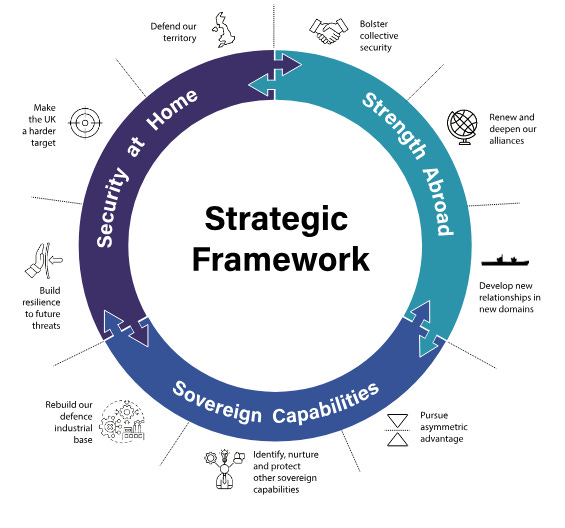
The three pillars are seen as mutually reinforcing.
The pillars are Security at Home, Strength abroad, and a rather vaguely headed “Increase Sovereign and Asymmetric capabilities.” The latter includes rebuilding “our defence industrial base.”
Overview
The Strategic Defence Review and the National Security Review are both written with carefully crafted sentences and are presented both as a necessary response to foreign aggression and as a means to boost the UK economy: a cure for stagnation.
The Starmer government won power on just 34% of the actual vote and was not exactly welcomed into office. He is not a politician with any widespread appeal and he is surrounded by acolytes who are, on the whole, of poor calibre.
The UK has borrowed heavily and has become a low growth and high tax economy with taxes likely to rise further. It is not well placed to fund a government “world-power” mindset that continually wishes to punch above its weight on the world stage. Yet, both the defence and security reviews, take the nation in the direction of never-ending involvement in conflicts the world over.
Those sectors of the economy concerned with arms and security are likely to receive much largesse from the government. Meanwhile, other sectors will suffer. Cuts to State benefits have already been announced and are creating unrest among Labour MPs. (The extent to which those get through Parliament remains to be seen - The Guardian 27 June 2025).
Whilst the nation must be prepared to cope with definite threats, I don’t think I am alone in being concerned about the government’s greater emphasis on military power and talk of harnessing the nation toward possible war. The increase in nuclear capability is a particular concern and may spur other nuclear powers to increase their own capabilities.
Amid the roll of drums, it would be good to see much greater emphasis on efforts to secure peace. Is that too much to ask? Maybe ….!
Some links
National Security Strategy - HERE
BBC 25 June 2025 - Five takeways from NATO’s big summit
RUSI - National Security Strategy - Reaction
The Guardian 26 June 2025 - Without dignity. leaders fell at Trump’s feet in The Hague - and for what? All NATO’s key problems remain
The Guardian 25 June 2025 - Protests at UK nuclear deterrent expansion
World Socialist Web Site 25 June 2025 - Britain’s national security strategy prepares militarisation of society