Elections 7 May 2026
A complex system of elections which appears to have changed the course of British politics.

Thursday 7 May 2026 - elections were held for (1) the entire Scottish Parliament, (2) the entire Senedd Cymru (Wales), (3) Local elections for 4,851 council seats across 134 of England’s 317 councils. (In addition, ‘shadow elections’ were held for two new unitary authorities due to be created in Surrey in 2027 - see HERE).
Complexity:
Governmental arrangements in the UK are complex and changes are in the pipeline.
The United Kingdom Parliament has two Houses (bicameral) - the House of Commons and the House of Lords. Only the House of Commons is elected. The last general election was in 2024 and was elected for a five year term but the Prime Minister is able to advise HM The King to dissolve Parliament and thereby trigger a general election. The United Kingdom Parliament is the UK’s supreme law-making body and sits at Westminster.
Scotland has a separate Parliament created by the Scotland Act 1998. This is a subordinate Parliament only having the powers devolved to it by the UK Parliament.
Wales also has a separate Welsh Parliament (or, in Welsh, Senedd Cymru) and has the powers devolved to it from Westminster. The Senedd was created (as an Assembly) by the Government of Wales Act 1998.
Northern Ireland has an Assembly created by the Northern Ireland Act 1998.
Local government is even more complex and is explained in detail at Explainer: Local government in England, Scotland and Wales - UK in a changing Europe. Local government has a big impact on the daily lives of citizens and, through Council Tax, it consumes huge sums of money. The powers of local government - whether a Mayor or a Council - are governed by national legislation.
Voting systems:
Across the UK, various voting systems are in use - e.g. the House of Commons uses first past the post etc. These are summarised at Electoral systems across the UK | Institute for Government.
The 7 May elections:
As well as the Scottish Parliament and Senedd Cymru elections, there were elections for some for 4,851 council seats across 134 of England’s 317 councils - (136 if the Surrey shadow elections are included).
The local government elections are explained more fully at - Local elections 2026 | Institute for Government.
Results:
Scotland -
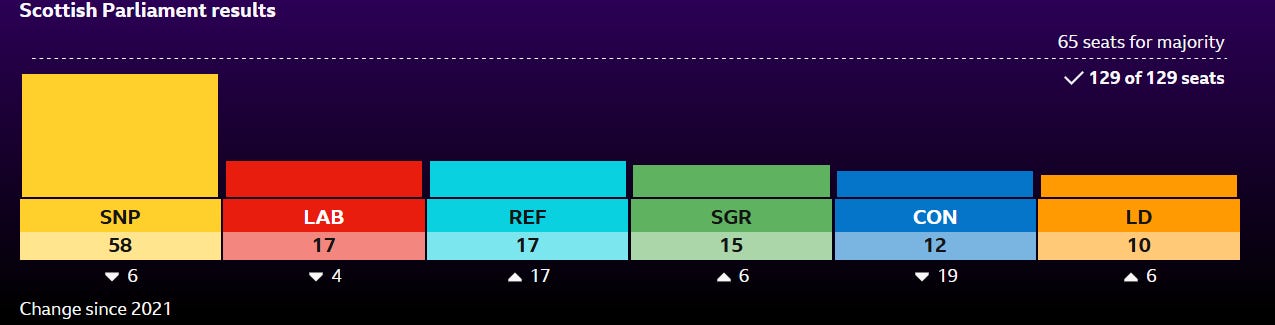
The diagram shows the breakdown of the result over the 129 seats. An overall majority requires 65 seats. The SNP is 7 seats short of that majority with Labour and Reform UK both at 17 seats.
Wales
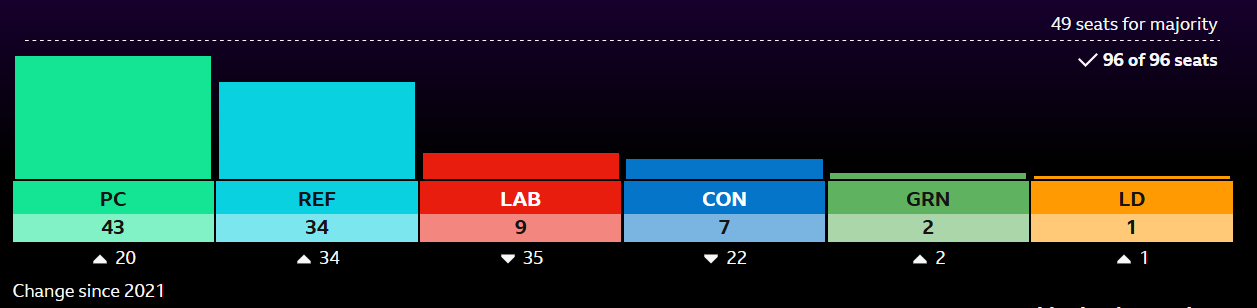
49 seats would be an overall majority. Plaid Cymru achieved 43 and Reform UK got 34 seats. Sigificantly, the Labour share fell markedly to just 9 seats.
English Councils
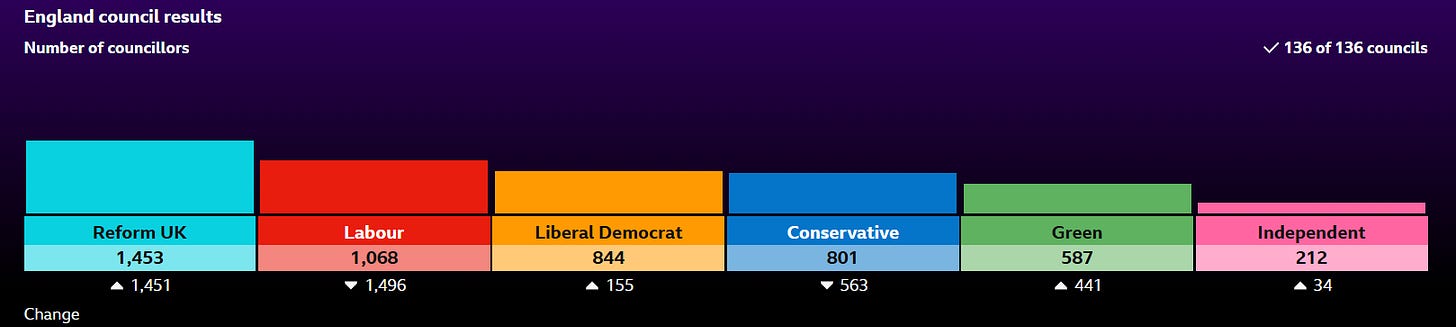
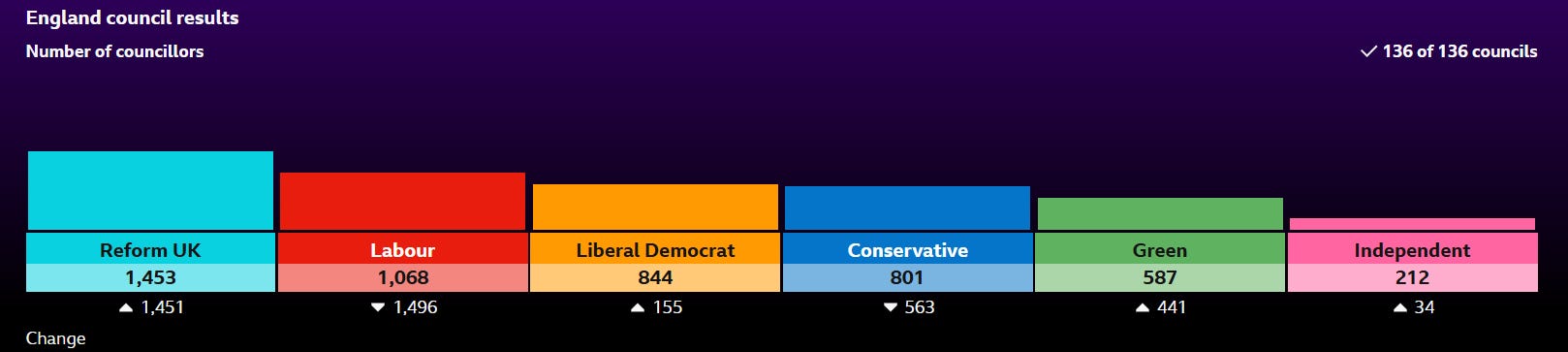
It is necessary to look at each Council to see exactly how the elections affected local council control. The diagram shows seats gained or lost. Reform UK gained 1451 seats, the Liberal Democrats gained 155, and the Green Party gained 441. The major losses were Labour - down 1496 seats and the Conservative Party down 563 seats.
Analysis:
It is plain that 7 May was definitely NOT a good day for Labour and was a winning day for Reform UK and, to a lesser extent, the Green Party.
Like the Gorton and Denton by-election, the result is an expression of dissatisfaction both with the UK Labour government and the Prime Minister Sir Keir Starmer.
In fairness, Labour did not inherit a superb situation from the Conservative Party which had been in continuous government since 2010. The nation wanted change from the austerity years of Cameron, May, Johnson, Truss, Sunak. The inheritance they left was bound to be a huge challenge to any new government and certainly not reversible in under two years.
However that may be, Labour has proved to be a government of high-taxation (discouraging enterprise). The national debt continues to increase whilst large sums of money are given to other countries. Illiberal (and unnecessary) policies have been introduced such as the Bill to remove trial by jury for all but the most serious of criminal cases. A coherent plan for important matters such as securing the future Energy supply seems to be lacking.
International events have revealed the hollowed-out state of the UK’s Armed Forces for which a vociferous media has tended to unfairly blame Labour.
Those are just some of the problems but, under Starmer, the government comes across as autocratic, lacking in empathy and failing to communicate adequately with the general public. The government has not dealt robustly enough with the endless barrage of well-funded media attacks on both Labour and Starmer personally.
It remains to be seen whether the now-damaged Prime Minister will survive these results but it is a serious concern that the Labour government is lacking in individuals with a clear ability to lead a national government and to defeat the buoyant Reform UK party.
As things stand, there is no guarantee that a change of Labour Party leader will turn Labour’s fortunes around and a general election in the present international climate - (war in the Middle East and Ukraine etc) - may well prove to be problematic for the UK.
At the time of writing, British politics has received a major shaking. Where the resultant waves will travel remains to be seen. I will add links (below) to any published analysis of the election results.
ooooo ——- ooooo
Links:
How Reform won votes from Swansea to Sunderland - BBC News
How the winner-takes-all voting system has turned on Labour and the Tories - BBC News
The significance of the 2026 elections for UK government | Institute for Government
Developments:
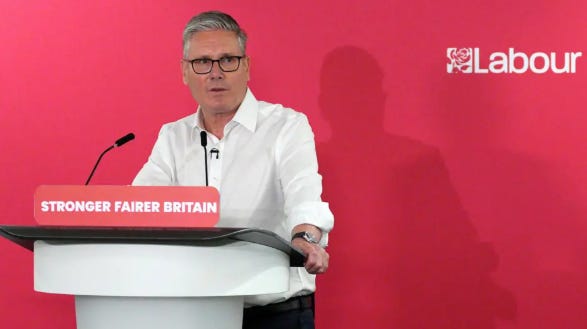
11 May 2026 - Video - Keir Starmer Delivers Speech To Save His Premiership (Full Remarks)
12 May 2026 - The Prime Minister is plainly wounded by the election results and his political future remains in some doubt.
13 May 2026 - Read all the ministers' resignation letters in full - BBC News
Who could challenge Keir Starmer as prime minister? - BBC News
The Labour Party Rule Book (Chapter 4) sets out the party’s procedure for selecting the party leader.
14 May 2026 - The fall out from the 7 May election results continues. On 13 May, the King’s Speech was held but against a background of uncertainty about Starmer’s future. Then came the Health Minister’s resignation …
Wes Streeting's resignation letter and Keir Starmer's response in full - BBC News
After that came a further development - Labour MP to stand down to allow Burnham run for byelection amid leadership row | Andy Burnham | The Guardian - One MP (Josh Simons Labour MP for Makerfield) will vacate his seat so that the Mayor of Greater Manchester (Andy Burnham) can stand for election. Of course there is no guarantee that Burnham will win this and we can doubtless expect Reform UK to throw all their resources into the contest.
Another potential candidate for a leadership contest is former Deputy Prime Minister Angela Rayner. She resigned in 2024 over problems with her tax affairs (stamp duty). On 14 May it was announced that - Angela Rayner has been cleared of tax fraud - and something doesn't add up. You may think that this announcement was rather too convenient.
15 May 2026 - How Rayner, Streeting and Burnham weakened PM in 12 hours of political drama - BBC News